

Introduction
Agate, one of nature’s most captivating gemstones, has fascinated collectors and enthusiasts for thousands of years. What makes each specimen truly unique is its distinctive patterning—the swirling bands, delicate plumes, and intricate formations that tell the story of its geological creation. Understanding agate patterns is essential for any serious collector, as these visual characteristics help identify varieties, compare specimens, and appreciate the remarkable processes that formed these stones over millions of years.
Whether you’re just beginning your collection or looking to deepen your expertise, recognizing the most common agate patterns will transform how you examine these remarkable specimens. This guide explores ten fundamental pattern types and, more importantly, shows you what features to look for when identifying each one.
Understanding Agate Pattern Formation
Before diving into specific patterns, it’s helpful to understand how these formations occur. Agates typically develop when silica-rich fluids enter cavities or fractures in rock and deposit successive layers of chalcedony and quartz. Changes in chemistry, mineral impurities, available space, and growth conditions contribute to the enormous variety of colors and patterns found in agate.
This is why two pieces of agate from the same general location can look dramatically different. One may contain crisp concentric bands while another contains plumes, tubes, dendrites, or combinations of several features.
Pro Tip: When examining an agate, use a bright LED light held at various angles to reveal subtle pattern details that might be difficult to see under normal room lighting.
How to Examine an Agate Before Identifying the Pattern
Before assigning a pattern name, spend a minute looking at the entire specimen rather than focusing immediately on its most colorful area.
- Examine the stone under normal indirect light.
- Look for obvious bands, inclusions, circles, tubes, or branching formations.
- Rotate the specimen slowly because patterns can change dramatically with orientation.
- Shine a bright light through thinner translucent areas.
- Use a loupe to inspect boundaries between bands and individual inclusions.
- Compare what you see with several pattern categories rather than relying on color alone.
Remember that pattern names describe visual and structural features rather than simply the color of the stone. An orange agate, for example, could be banded, fortification, plume, lace, or another pattern depending on its internal structure.
The 10 Essential Agate Patterns for Collectors
1. Banded Agate

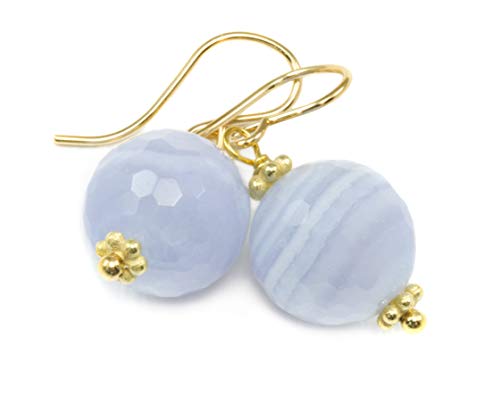
Banded agate represents the most recognizable and classic agate pattern. These specimens display successive layers of varying colors or translucency that commonly follow the contours of the cavity in which the agate formed. The bands can range from extremely fine lines to much broader layers and can appear in numerous color combinations.
- Look for repeated layers following similar contours
- Some bands may be translucent while others appear more opaque
- Band thickness can vary throughout a single specimen
- Patterns may curve around the outer shape of the original cavity
How to recognize it:
- Hold the agate under bright indirect light.
- Locate two or more clearly distinguishable layers.
- Follow one band across the visible surface.
- Check whether neighboring bands roughly follow the same contour.
- Rotate the stone to see whether the layering continues around another surface.

View on AmazonAs an Amazon Associate, I earn from qualifying purchases.
View on AmazonAs an Amazon Associate, I earn from qualifying purchases.
Pro Tip: Don’t judge band quality from a single small area because the clarity, thickness, and continuity of bands can vary considerably across the same specimen.
2. Fortification Agate
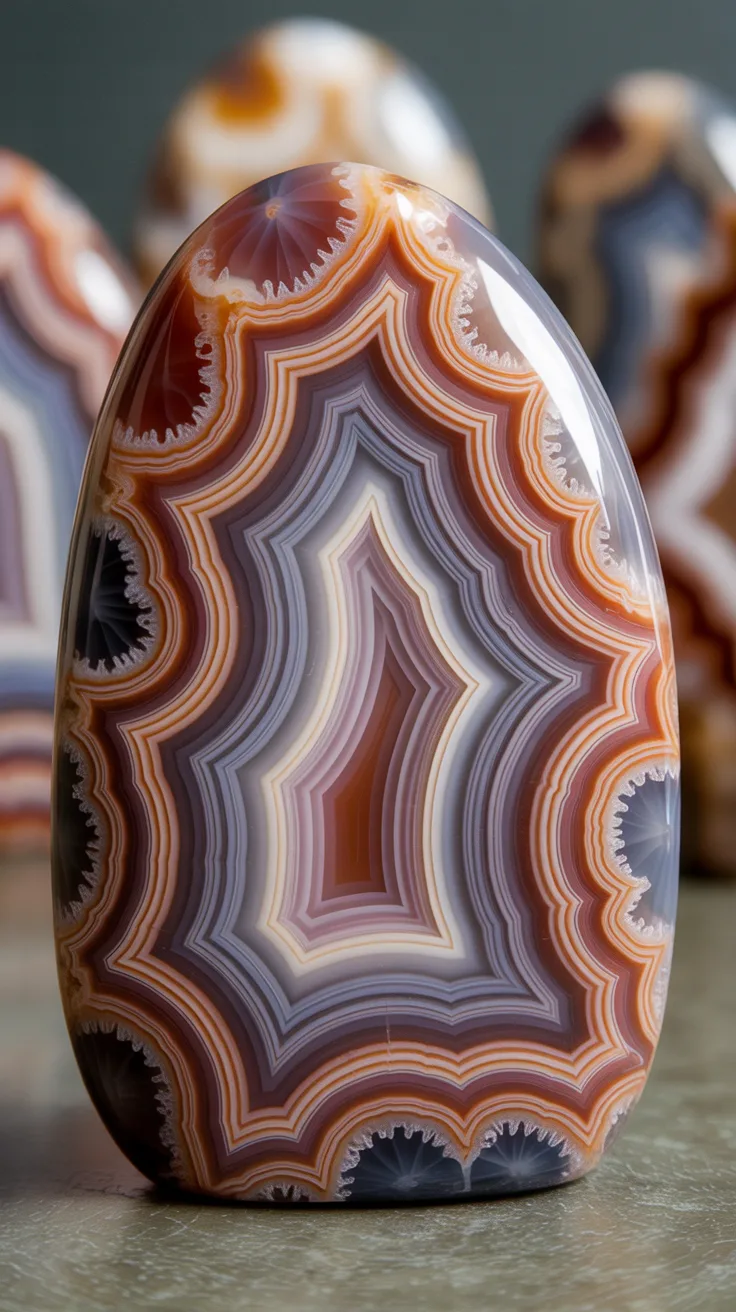
Fortification agate is a distinctive form of banded agate in which the bands repeatedly follow angular or irregular contours. Viewed on a polished face, these formations can resemble the walls and bastions of an old fortress viewed from above, which inspired the name.
The easiest way to understand the pattern is to imagine ordinary agate banding becoming increasingly angular. Instead of smooth oval rings, the layers make repeated turns while maintaining roughly parallel spacing.
How to recognize it:
- Look for repeated bands rather than isolated angular markings.
- Follow the bands and watch for noticeable corners and directional changes.
- Check whether several neighboring layers repeat those same turns.
- Look toward the center for smaller nested versions of the outer pattern.

View on AmazonAs an Amazon Associate, I earn from qualifying purchases.

View on AmazonAs an Amazon Associate, I earn from qualifying purchases.
Strong examples can produce complex geometric patterns even though the structure developed through natural mineral deposition.
3. Plume Agate
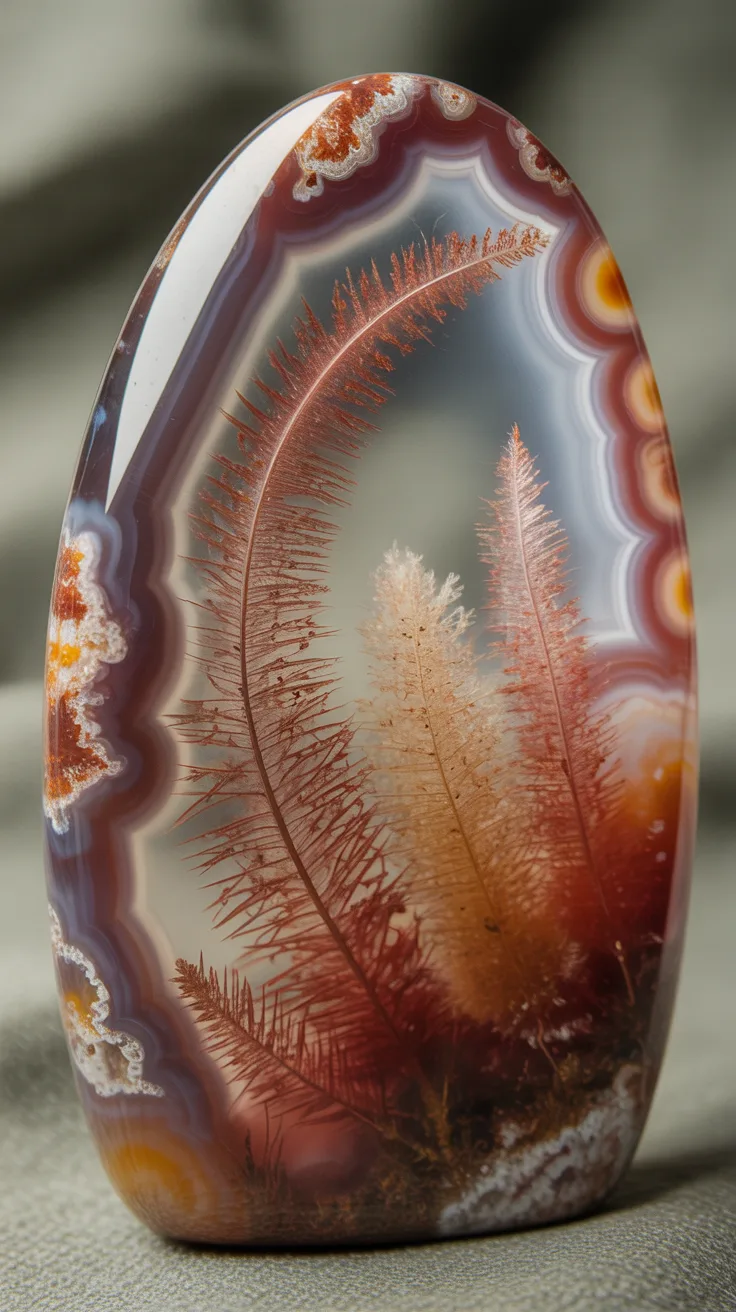
Plume agates contain feathery or plume-like mineral inclusions within chalcedony. Depending on the specimen, these formations can resemble feathers, flames, underwater plants, clouds, or branching sprays suspended inside the stone.
- Red and orange coloration may be associated with iron-bearing minerals
- Dark plume structures can contain manganese or other mineral material
- Different mineral assemblages can produce varied colors and shapes
How to recognize it:
- Look through translucent areas of the specimen.
- Identify formations that appear suspended inside the chalcedony rather than simply painted across its surface.
- Look for repeated feathery, flame-like, or plume-shaped growth.
- Rotate the stone to see whether the inclusions have visible depth.
- Compare the structure with moss and dendritic patterns before making an identification.
Plume agate can vary enormously in appearance, making side-by-side comparison with known specimens particularly useful for beginners.

View on AmazonAs an Amazon Associate, I earn from qualifying purchases.

View on AmazonAs an Amazon Associate, I earn from qualifying purchases.
4. Moss Agate
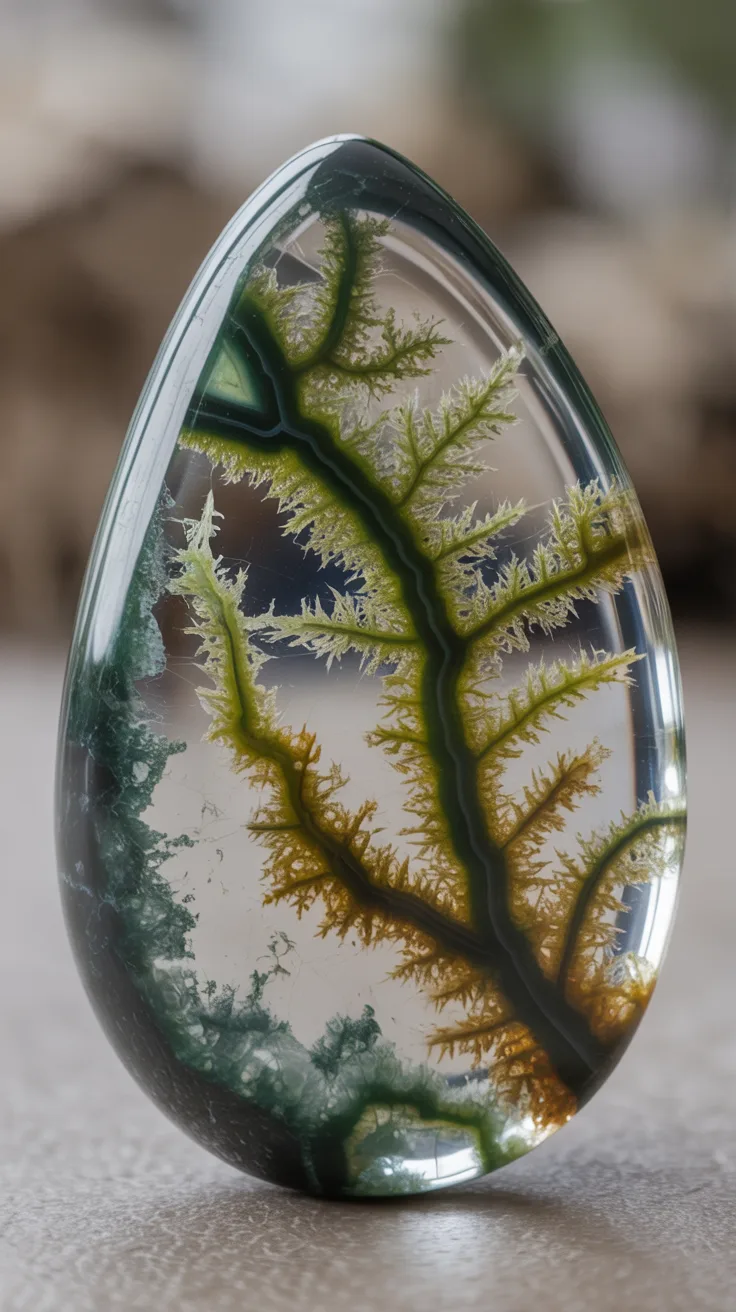
Despite its name, moss agate contains no actual moss. Mineral inclusions create branching, cloud-like, or filamentous patterns that resemble moss, vegetation, or tiny underwater landscapes inside translucent chalcedony.
Green is perhaps the color most strongly associated with moss agate, but moss-like inclusions can occur in other colors as well.
How to recognize it:
- Hold the specimen against a bright light if it is translucent enough.
- Look for irregular branching or moss-like inclusions.
- Notice whether the formations appear organic and loosely distributed.
- Check for areas of clear or translucent chalcedony surrounding the inclusions.
- Compare the structure with more organized plume and dendritic formations.
Pro Tip: Moss patterns often have a more irregular, diffuse appearance than the strongly feathered structures commonly associated with plume agate.
5. Dendritic Agate
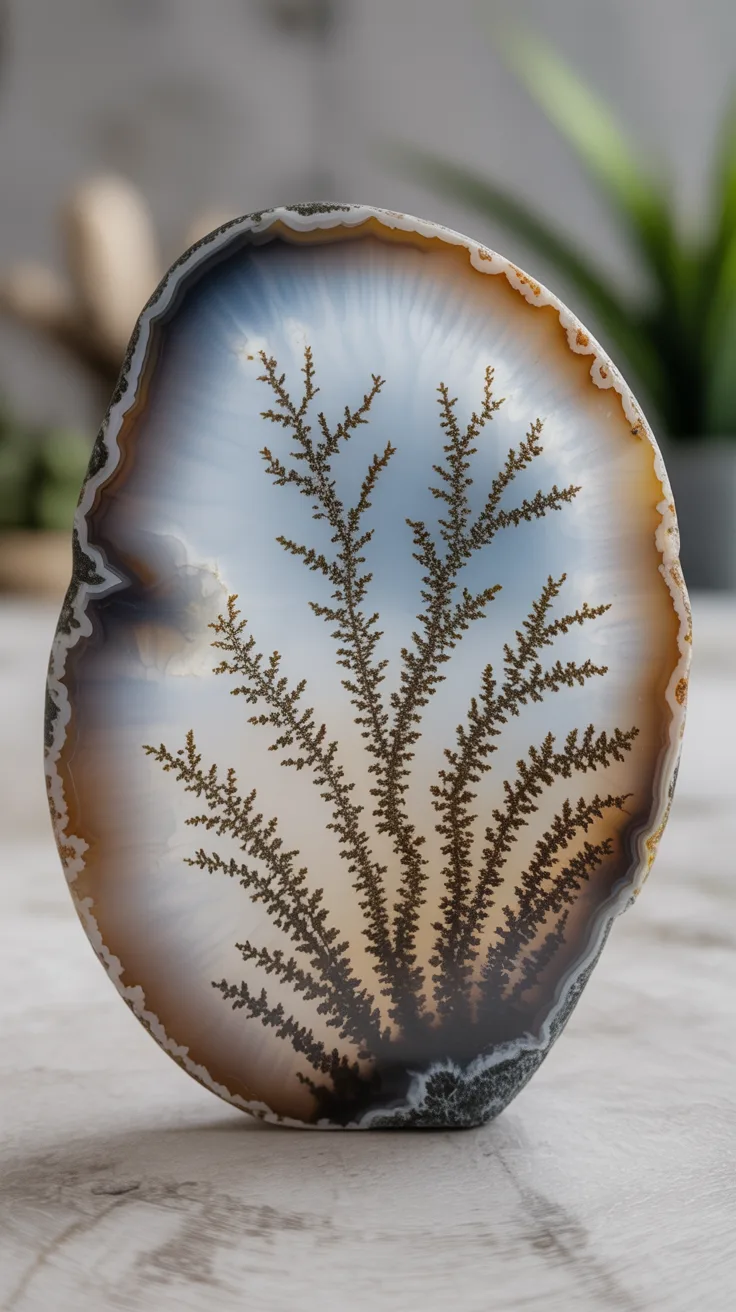
Dendritic agates feature branching mineral patterns that can resemble trees, ferns, shrubs, or frost spreading across glass. The word “dendritic” refers to a branching, tree-like form and describes the appearance of these mineral deposits.
Some of the most visually interesting specimens resemble miniature landscapes, with dark branching structures appearing against a lighter chalcedony background.
How to recognize it:
- Look for a distinct central branch or network of branches.
- Follow the formation outward toward progressively smaller branches.
- Look for repeated tree-like or fern-like geometry.
- Compare the sharply defined branching with the softer appearance of many moss patterns.
Dendritic patterns can be strikingly detailed, so a loupe is particularly helpful when studying smaller specimens.
6. Eye Agate
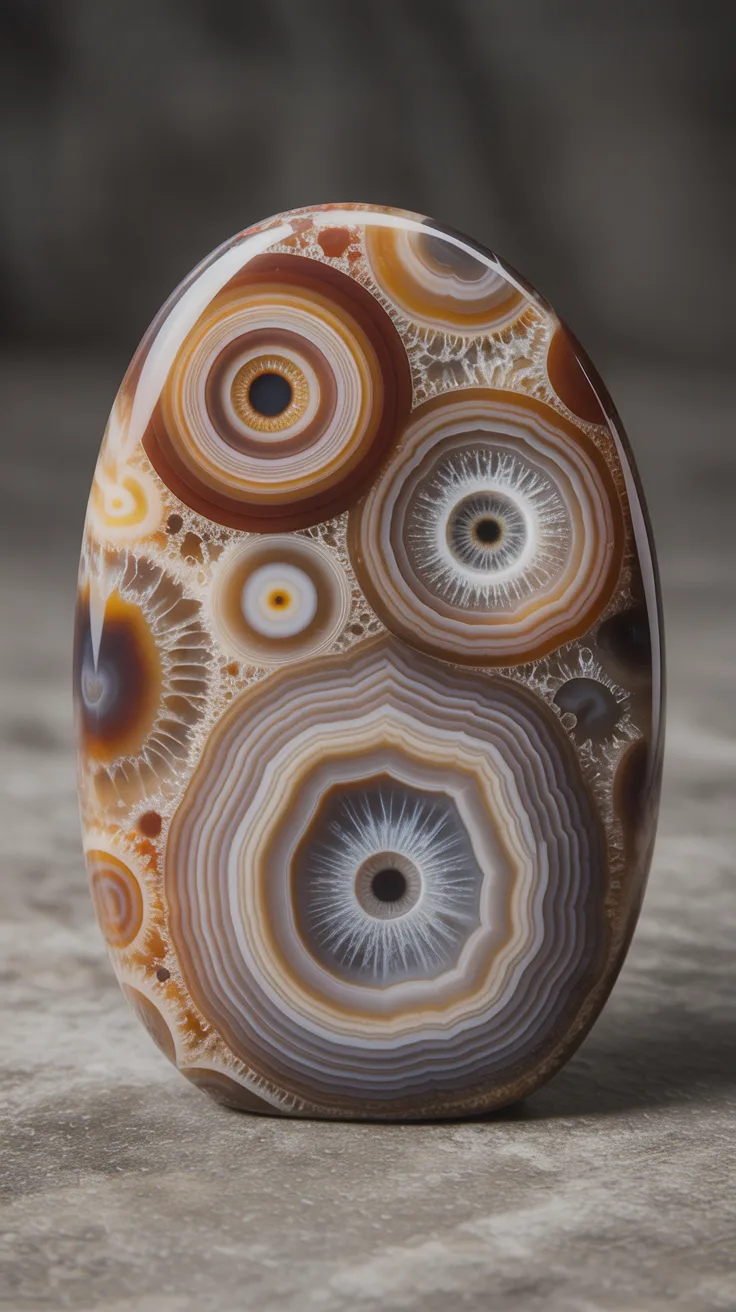
Eye agates contain circular or oval concentric formations that resemble eyes when exposed on the surface of the stone. These features can occur singly or as multiple eye-like structures across one specimen.
| Eye Type | What to Look For |
|---|---|
| Single Eye | One prominent circular or oval concentric formation |
| Multiple Eyes | Several separate eye-like formations within one specimen |
| Nested Eyes | Multiple concentric layers surrounding a central point |
How to recognize it:
- Look for circular or oval formations with a visible center.
- Check for rings surrounding that central point.
- Rotate the specimen to determine whether additional eyes are present.
- Use magnification to inspect very small concentric structures.
The appearance of eye patterns can depend strongly on how the specimen has been cut, since slicing through a three-dimensional structure at different angles changes its visible shape.
7. Lace Agate
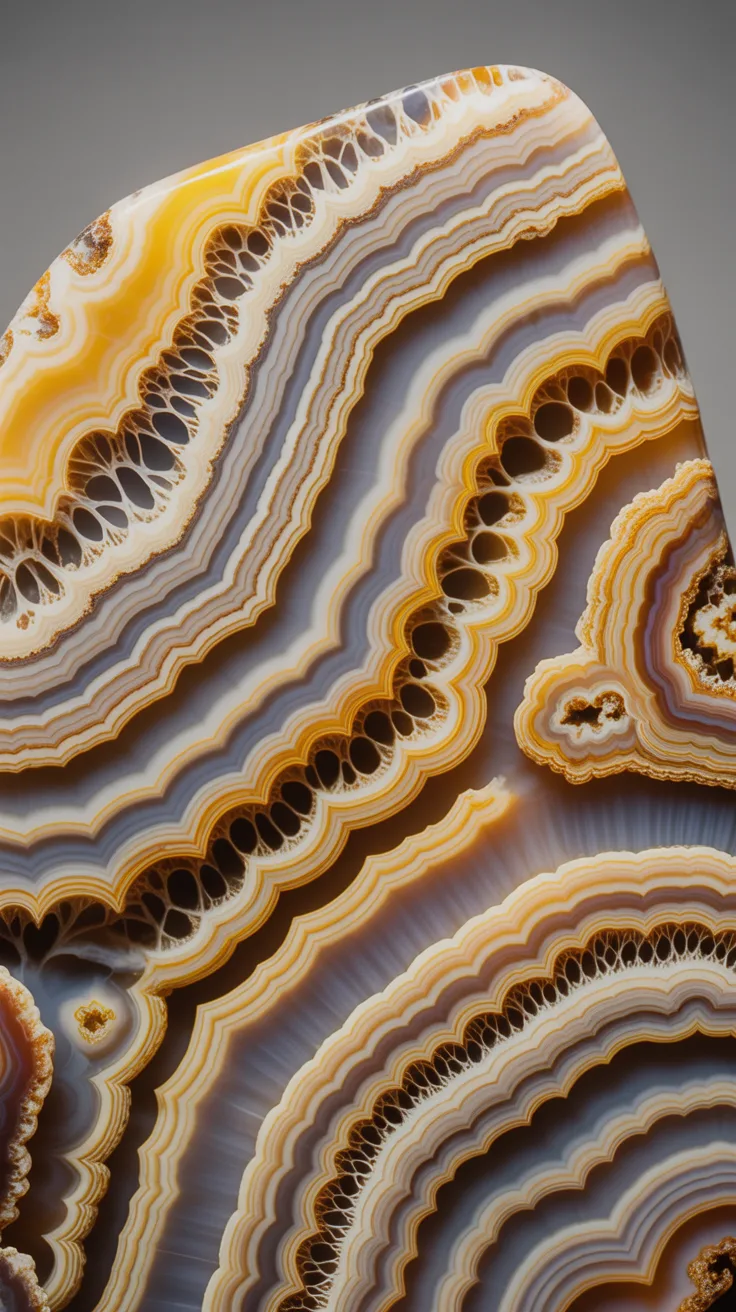
Lace agates display intricate twisting, looping, and interwoven bands that can resemble lace, ribbons, or elaborate fabric patterns. Rather than following one simple set of concentric contours, the banding creates a visually busy network of curves and folds.
Mexican Crazy Lace Agate is one of the best-known examples and is famous for intricate banding commonly seen in combinations of cream, gray, yellow, orange, red, and brown.
How to recognize it:
- Look for numerous thin bands packed closely together.
- Follow the lines to see whether they curve, loop, and change direction repeatedly.
- Look for areas where several patterns appear to interact.
- Examine the specimen under magnification to appreciate finer banding.
Pro Tip: Color alone should not be used to identify Crazy Lace Agate because the complex lace-like banding is the more important identifying feature.
8. Tube Agate
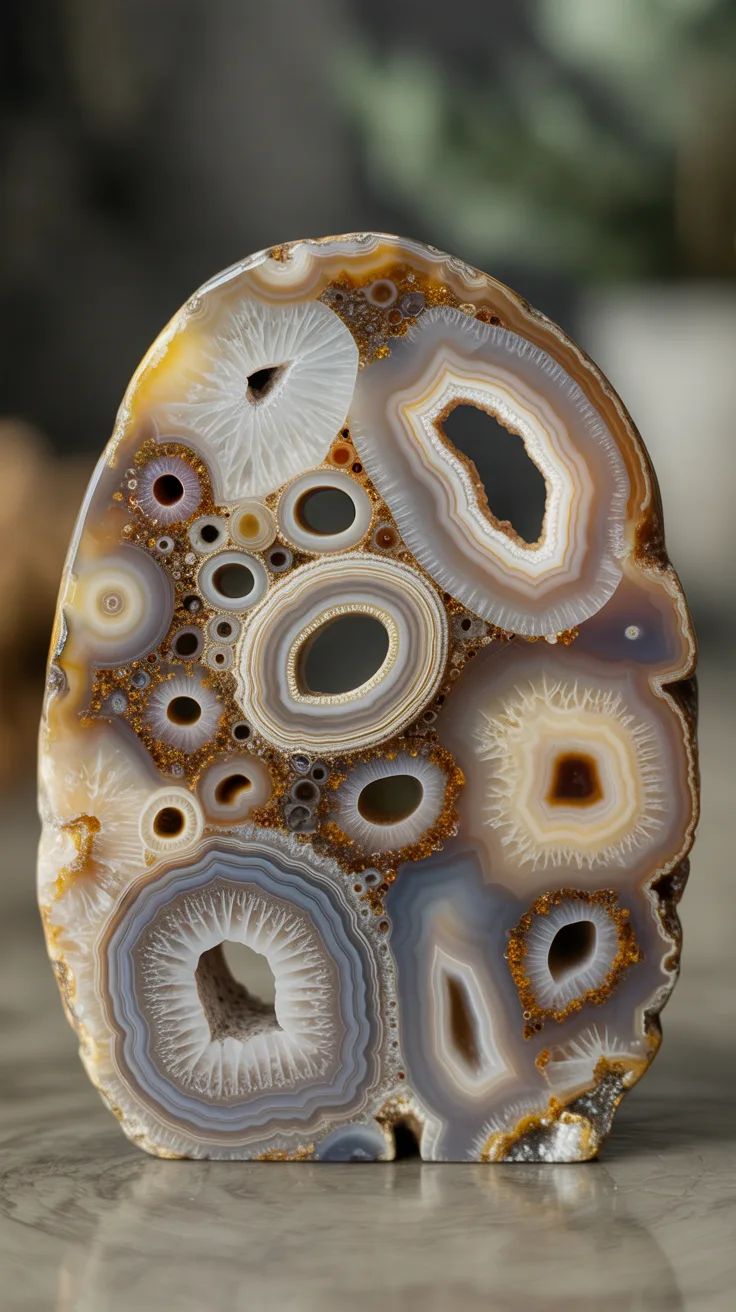
Tube agates contain elongated tubular structures within the chalcedony. Depending on how a specimen is cut, these features may appear as long tubes, circular cross-sections, or unusual concentric structures.
- Lengthwise cuts can expose elongated tube structures
- Cross-sections may reveal circles or rings
- Tubes can be hollow, partially filled, or completely mineralized
- Banding can develop around individual tubular structures
How to recognize it:
- Look for repeated circular features on a cut surface.
- Examine the specimen from another direction if possible.
- Check whether circular features extend into elongated structures.
- Look for banding wrapped around individual tubes.
Orientation matters tremendously with tube agate, so rough material and slabs cut in different directions can appear surprisingly different.
9. Sagenitic Agate
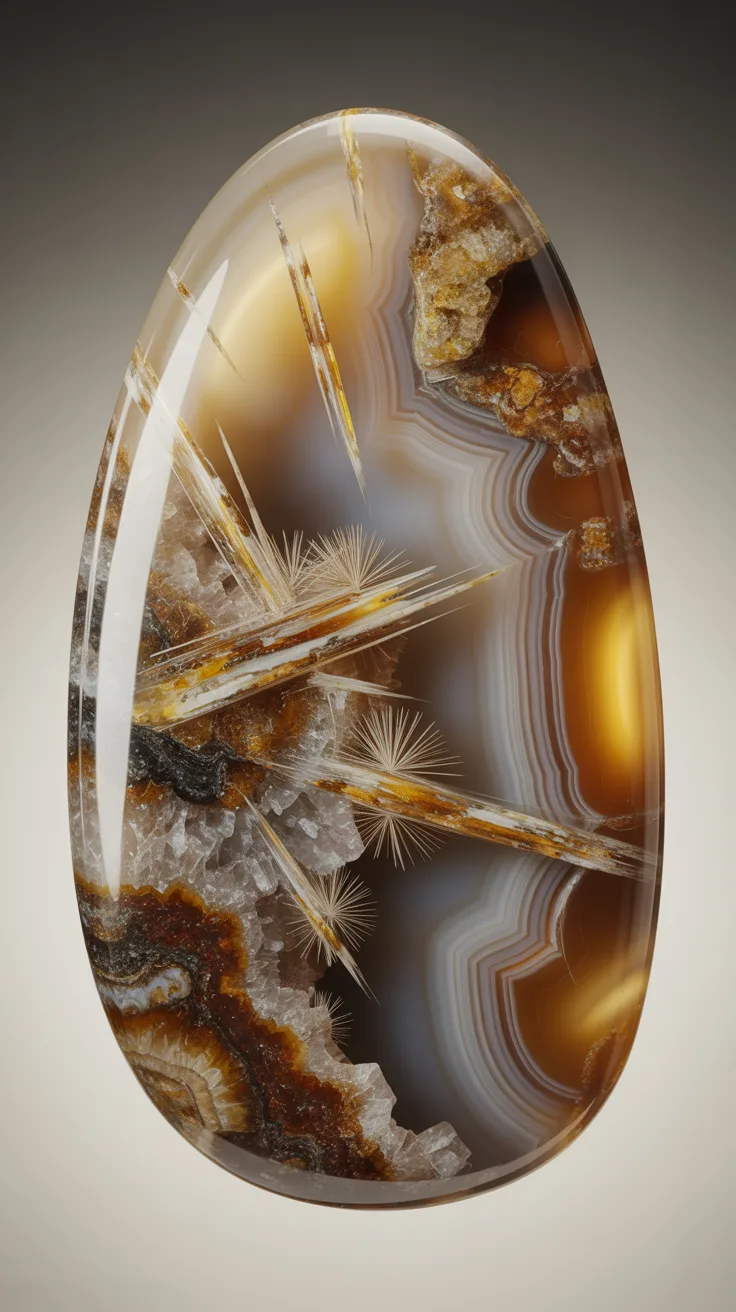
Sagenitic agate contains needle-like or acicular mineral inclusions enclosed within chalcedony. These inclusions may occur as isolated needles, sprays, radiating clusters, or dense networks depending on the minerals and formation conditions involved.
The needles can contrast dramatically with translucent chalcedony, making well-exposed examples particularly attractive for display and lapidary work.
How to recognize it:
- Illuminate the specimen from behind when possible.
- Look for straight or slightly curved needle-like inclusions.
- Check whether needles occur individually or in radiating groups.
- Rotate the specimen to determine whether the needles extend through the stone.
- Use a loupe to separate genuine mineral needles from surface scratches.
Some specimens combine sagenitic inclusions with banding, plumes, or other agate features, so more than one descriptive pattern term may be appropriate.
10. Iris Agate

Iris agate can display rainbow-like spectral colors when very fine banding interacts with transmitted light. The effect is associated with extremely fine structures capable of diffracting light, and it may not be obvious when the specimen is viewed under ordinary reflected lighting.
Because lighting and specimen thickness matter, iris characteristics are often best observed in thin slabs held in front of a strong light source.
How to check for the iris effect:
- Use a thin polished agate slab.
- Position a strong white light behind the specimen.
- Look through the slab toward the transmitted light.
- Slowly change the viewing angle.
- Watch for rainbow-like spectral colors appearing within finely banded areas.
Pro Tip: A colorful agate is not automatically iris agate because the identifying feature is the optical spectral effect produced under suitable lighting rather than ordinary pigment color.
Quick Agate Pattern Identification Guide
| Pattern | Main Feature | What It Can Resemble |
|---|---|---|
| Banded | Repeated layered bands | Nested contours or rings |
| Fortification | Angular repeated bands | Fortress walls |
| Plume | Feathery mineral inclusions | Feathers, flames, or plumes |
| Moss | Irregular organic-looking inclusions | Moss or vegetation |
| Dendritic | Distinct branching formations | Trees or ferns |
| Eye | Concentric circular formations | Eyes |
| Lace | Complex looping bands | Lace or ribbons |
| Tube | Tubular internal structures | Tubes or circular cross-sections |
| Sagenitic | Needle-like inclusions | Needles or sprays |
| Iris | Spectral effect in transmitted light | Rainbow colors |
Building Your Own Agate Pattern Reference Collection
One of the easiest ways to become better at identifying agate patterns is to build a small reference collection rather than trying to memorize everything from photographs.
You don’t need expensive collector-grade specimens. Inexpensive examples that clearly demonstrate a particular feature can be more useful for learning than visually spectacular stones with complicated combinations of patterns.
How to build your reference set:
- Start with an obvious banded agate because its pattern is relatively easy to recognize.
- Add specimens showing moss, plume, dendritic, and lace features.
- Label each specimen with its pattern and known locality if available.
- Photograph each stone under consistent lighting.
- Record why you identified it as a particular pattern.
- Compare new finds with your known examples.
- Update identifications as your knowledge improves.
A rock and mineral display case can keep a small reference collection organized while making specimens easy to compare.
Essential Tools for Studying Agate Patterns
You can identify many obvious patterns with nothing more than good lighting, but a few inexpensive tools make close examination considerably easier.
- 10x loupe – Helps examine fine bands and small mineral inclusions
- LED flashlight – Useful for transmitted and angled illumination
- Light pad – Helpful when examining translucent slabs
- Soft brush – Removes dirt from rough specimens before examination
- Notebook – Useful for recording locality, dimensions, and observations
- Calipers – Helpful for documenting specimen dimensions
A 10x jeweler’s loupe for rock collecting makes fine banding and tiny inclusions much easier to examine.
What About Rough Agates?
Recognizing patterns becomes more difficult when an agate has not been cut or polished. Weathered surfaces can conceal much of the internal structure, and the most interesting pattern may lie completely beneath the exterior.
Begin by cleaning rough material carefully and examining naturally broken or translucent areas. Wetting the surface temporarily can also make colors and structures easier to see.
If you’re interested in revealing patterns yourself, cutting or tumbling suitable material can expose features that are difficult to appreciate in rough form.
A beginner rock tumbler kit provides an approachable way to start polishing suitable rocks at home.
Building Pattern Recognition Skills
Developing expertise in identifying agate patterns requires hands-on experience combined with systematic study. Consider these approaches for improving pattern recognition abilities:
- Handle specimens whenever possible because photographs cannot capture every visual nuance.
- Study labeled reference collections at museums, gem shows, and mineral clubs.
- Join collector groups and compare identifications with experienced enthusiasts.
- Document personal collections with detailed photographs and notes.
- Compare specimens from different geographic locations to understand regional variations.
- Revisit uncertain identifications as you gain experience.
If rockhounding is becoming a broader hobby, a beginner rockhounding kit can provide basic field tools for collecting and examining specimens.
For readers who also want to explore prospecting, a beginner gold panning kit provides the basic equipment needed to try recreational panning.
Frequently Asked Questions
How can collectors distinguish natural agate patterns from artificially enhanced specimens?
Look at the entire specimen rather than judging it by vivid color alone. Dyed material can sometimes show unusually intense coloration or concentrations of color in fractures and porous areas, while natural agates can also display surprisingly strong colors. Magnification, comparison with known material, provenance, and seller disclosure are useful when treatment status matters.
Do certain agate patterns indicate higher value than others?
Pattern type alone does not determine value. Size, condition, pattern quality, color, translucency, locality, rarity, cutting quality, provenance, and collector demand can all affect what someone is willing to pay for an individual specimen.
Can multiple pattern types appear in a single agate specimen?
Yes. A single specimen can contain several recognizable features, such as banding combined with plumes or needle-like inclusions. These combination pieces are useful reminders that pattern terminology describes visible characteristics rather than rigid categories that every agate must fit exclusively.
How does geographic origin affect agate patterns?
Different agate-producing regions can develop characteristic appearances because their geological environments and mineral chemistry differ. Locality can therefore provide useful context, but visual appearance alone is not always enough to establish geographic origin with certainty.
What tools are useful for examining agate patterns?
A 10x loupe and bright LED light are useful starting tools. Collectors examining translucent slabs may also benefit from a light pad, while good photography and written notes make it easier to compare specimens over time.
Which agate pattern should beginners learn first?
Banded agate is an excellent starting point because the repeated layering is usually easier to recognize than many inclusion-based patterns. Once you can confidently follow bands through a specimen, comparing ordinary banding with fortification, lace, eye, and other structures becomes much easier.