
Introduction
When exploring the world of semi-precious gemstones, few comparisons generate as much confusion as moss agate vs tree agate. Both stones feature stunning dendritic patterns that resemble natural foliage, and both belong to the chalcedony family. However, these two gemstones possess distinct characteristics that set them apart in terms of appearance, value, and application.

Understanding the differences between these stones matters for collectors, jewelry makers, and crystal enthusiasts alike. Whether selecting a stone for a specific piece of jewelry or building a mineral collection, knowing how to distinguish moss agate from tree agate ensures informed purchasing decisions and proper identification.
Beginners can practice these identification techniques with moss agate and tree agate specimens.
1. Base Color and Transparency: The Most Obvious Distinction
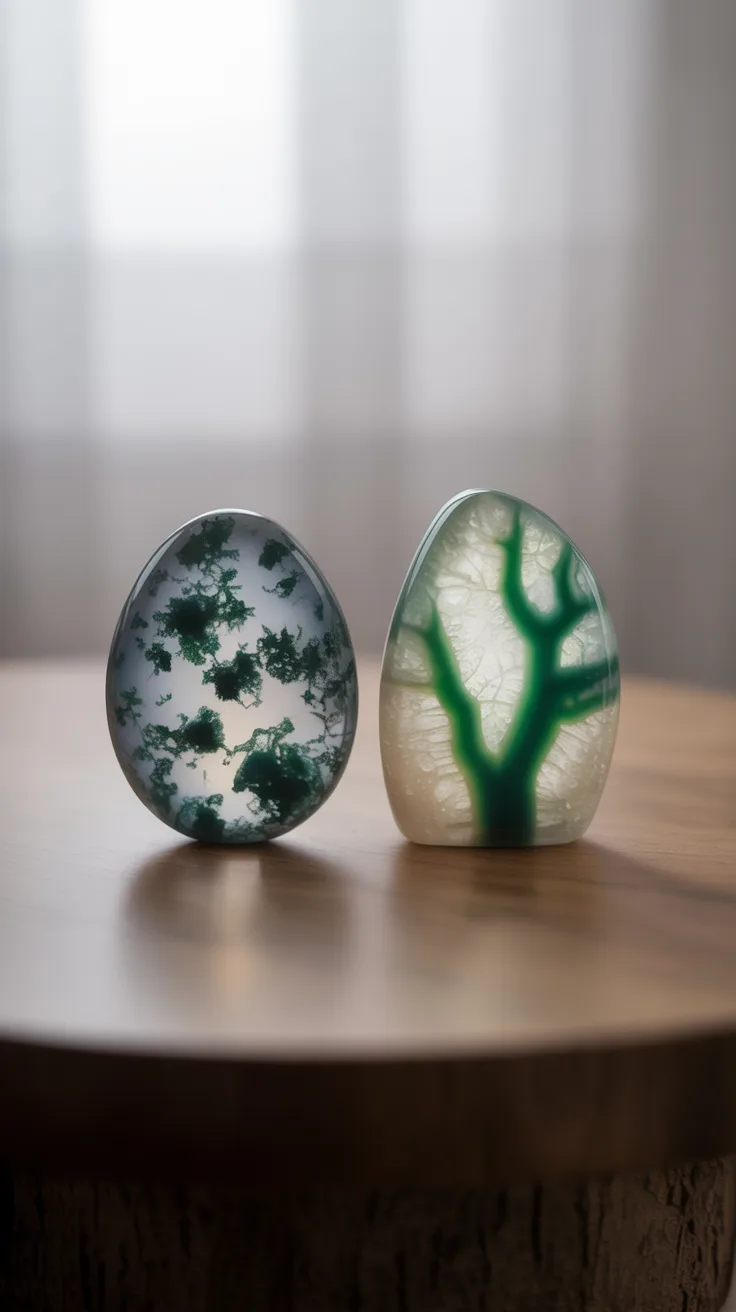
The most immediately noticeable difference between moss agate and tree agate lies in their base color and transparency levels. Moss agate typically features a translucent to semi-transparent base, allowing light to pass through the stone and illuminate its internal inclusions. This transparency creates a sense of depth that makes the green patterns appear to float within the crystal.
Tree agate, in contrast, presents an opaque white or cream-colored base. No light passes through this stone, giving it a solid, milky appearance. The white background creates a stark canvas against which the green dendritic patterns stand out with exceptional clarity.
- Moss Agate: Clear to milky translucent base, often with gray or blue undertones
- Tree Agate: Solid opaque white or cream base with no transparency
How to check:
- Move to a dim room so outside light does not interfere with the test.
- Hold the stone between your fingers and place a small flashlight directly behind it.
- Look closely at thinner edges as well as the center of the specimen.
- If light passes through and reveals inclusions inside the stone, it is likely moss agate.
- If the white or cream base remains opaque, the specimen is more likely tree agate.

View on AmazonAs an Amazon Associate, I earn from qualifying purchases.

View on AmazonAs an Amazon Associate, I earn from qualifying purchases.
A small LED flashlight for rock collecting makes this simple comparison easier to perform.
Pro Tip: Hold the stone up to a light source. If any light passes through, even slightly, the specimen is likely moss agate rather than tree agate.
2. Pattern Formation and Inclusion Types
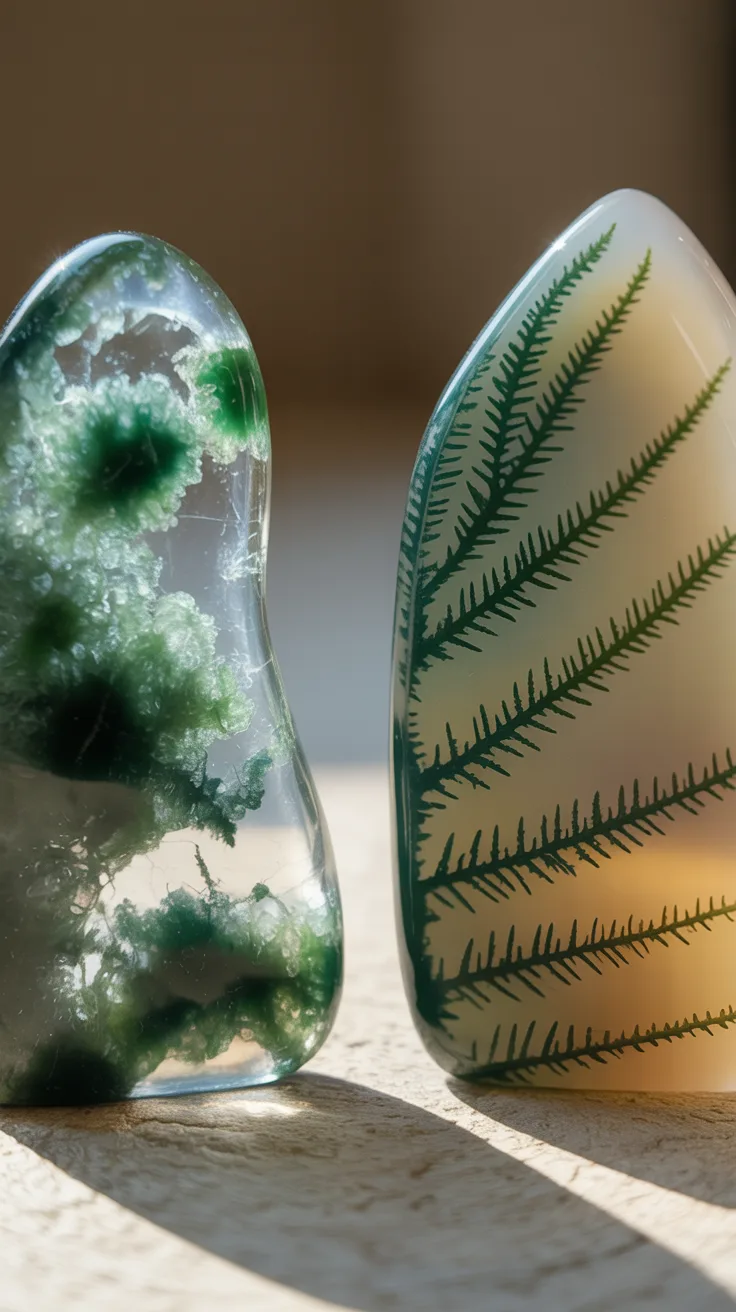
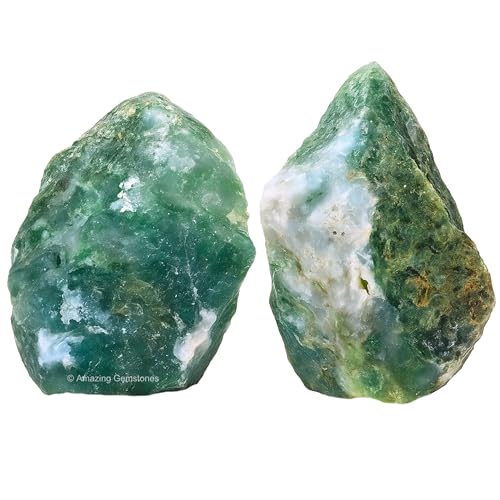
While both stones display green patterns, the nature of these inclusions differs significantly. Moss agate contains mineral inclusions—primarily chlorite, hornblende, or iron oxides—that create wispy, moss-like formations throughout the stone. These inclusions appear three-dimensional due to the stone’s transparency.
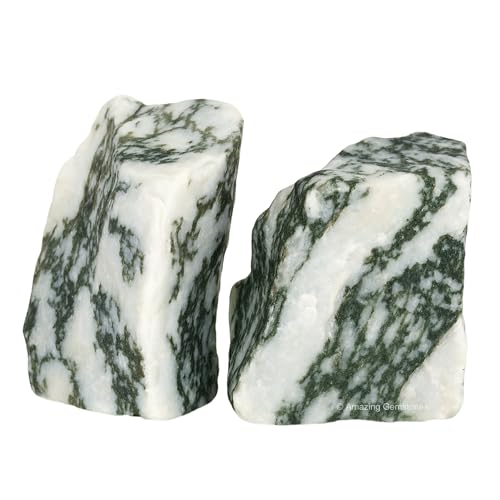
Tree agate features dendritic inclusions composed mainly of manganese or iron oxides. These patterns spread across the surface in branching formations that genuinely resemble tree branches or fern fronds. The patterns in tree agate tend to appear more two-dimensional and surface-oriented compared to the depth found in moss agate.
When comparing specimens, slowly rotate each stone under a bright light. Moss agate often gives the impression that its green inclusions sit at different depths inside the material, while tree agate tends to display sharper branching patterns against its pale background.
View on AmazonAs an Amazon Associate, I earn from qualifying purchases.
View on AmazonAs an Amazon Associate, I earn from qualifying purchases.
Pro Tip: Examine the pattern structure closely. Moss agate inclusions appear fluffy and cloud-like, while tree agate patterns show distinct branching structures similar to frost on a window.
3. Color Variations Beyond Green
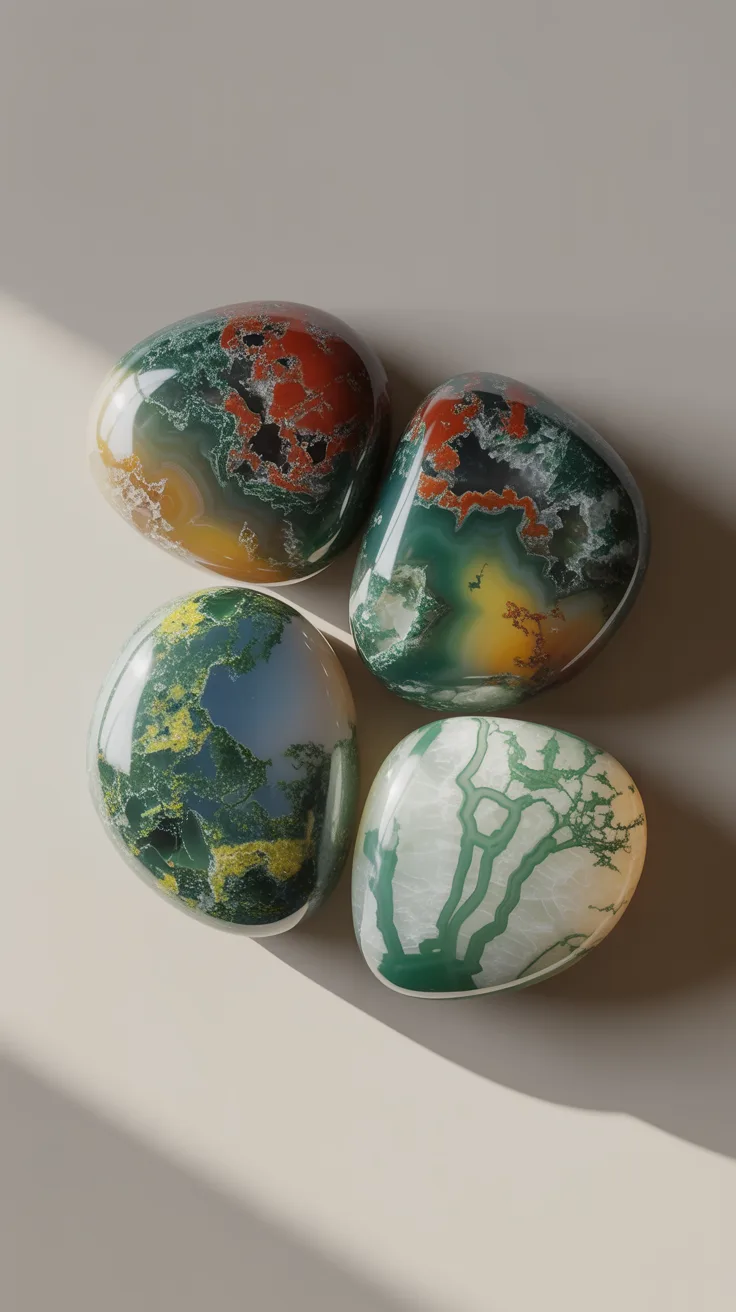
Although green dominates both stones, their secondary color possibilities vary considerably. Moss agate displays a broader spectrum of colors within its inclusions, including:
- Deep forest green
- Red and brown (from iron oxide)
- Black inclusions
- Yellow and golden tones
- Blue-gray undertones in the base
Tree agate maintains a more consistent color palette, primarily featuring green dendritic patterns against its white base. Occasionally, specimens may show brown or black dendrites, but the color range remains more limited than moss agate. This consistency makes tree agate easier to match in jewelry sets.
For a quick visual comparison, place several specimens side by side on a neutral white surface under natural light. Look beyond the dominant green and note the color of the base material, secondary inclusions, and any brown, red, yellow, gray, or black areas.
4. Geological Formation Differences
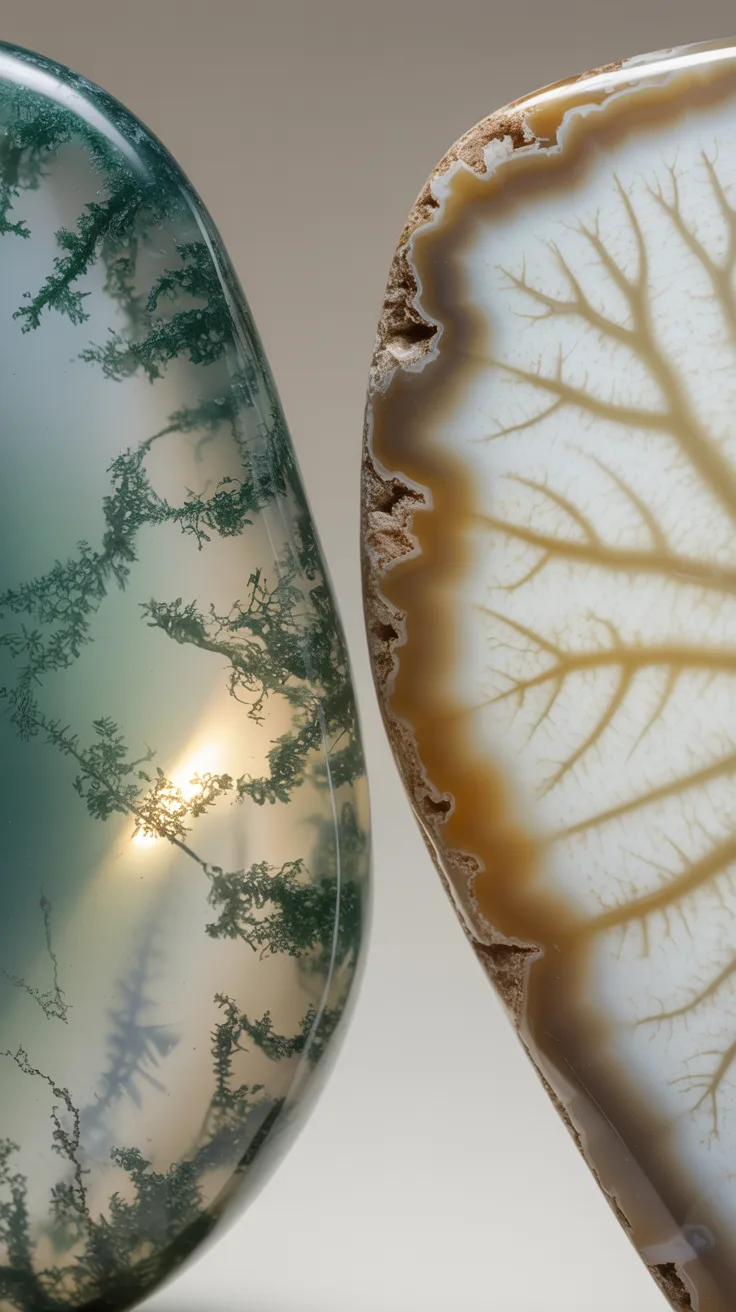
Understanding how these stones form reveals why they appear so different despite their similar compositions. Moss agate develops when silica-rich solutions deposit in volcanic rock cavities. As the silica crystallizes, mineral-rich fluids create the characteristic inclusions trapped within the forming chalcedony.
Tree agate forms through a slightly different process where manganese and iron solutions seep through already-formed chalcedony along microscopic fractures. This explains why tree agate patterns appear more surface-oriented—they literally form along existing planes within the stone rather than being suspended throughout.
Both stones share the same hardness rating of 6.5-7 on the Mohs scale, making them equally suitable for jewelry applications.
When examining a polished specimen, viewing it from several angles can help make this formation difference easier to understand. The moss-like inclusions in moss agate can appear suspended within the translucent material, whereas tree agate’s branching patterns are usually easier to see against its opaque background.
5. Geographic Origins and Availability
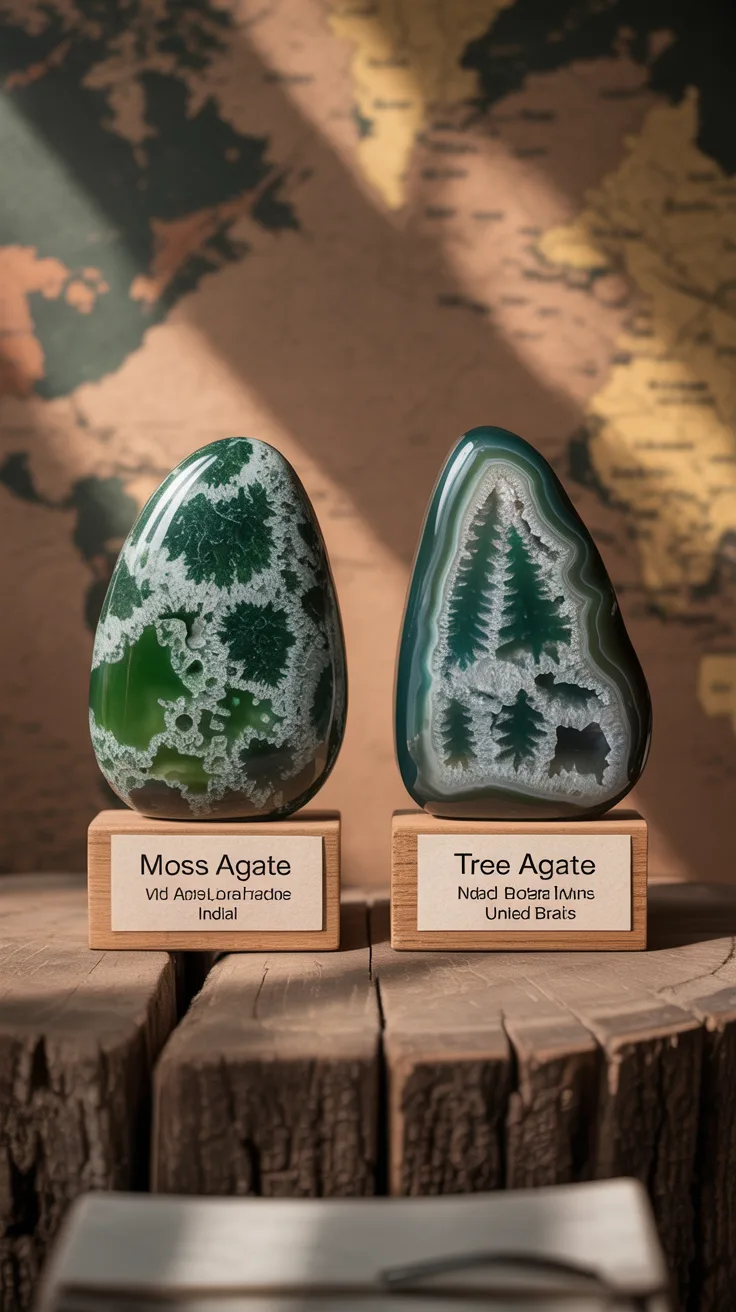
The sourcing locations for these stones overlap in some regions but differ in primary deposits. Major sources for each stone include:
Moss Agate Primary Sources
- India (largest commercial producer)
- Brazil
- Uruguay
- United States (Montana, specifically)
- Russia
Tree Agate Primary Sources
- India (dominant source)
- Brazil
- United States
- Kazakhstan
India remains the primary commercial source for both stones, though moss agate enjoys wider global distribution. This affects availability and pricing in different markets.
When buying a specimen, check whether the seller provides a locality rather than relying only on a general stone name. Keeping the location information with the specimen also makes a collection easier to organize and compare over time.
Pro Tip: When purchasing either stone, inquire about the origin. Indian specimens tend to be more affordable, while Montana moss agate commands premium prices due to its unique coloration and limited supply.
6. Market Value and Pricing Considerations
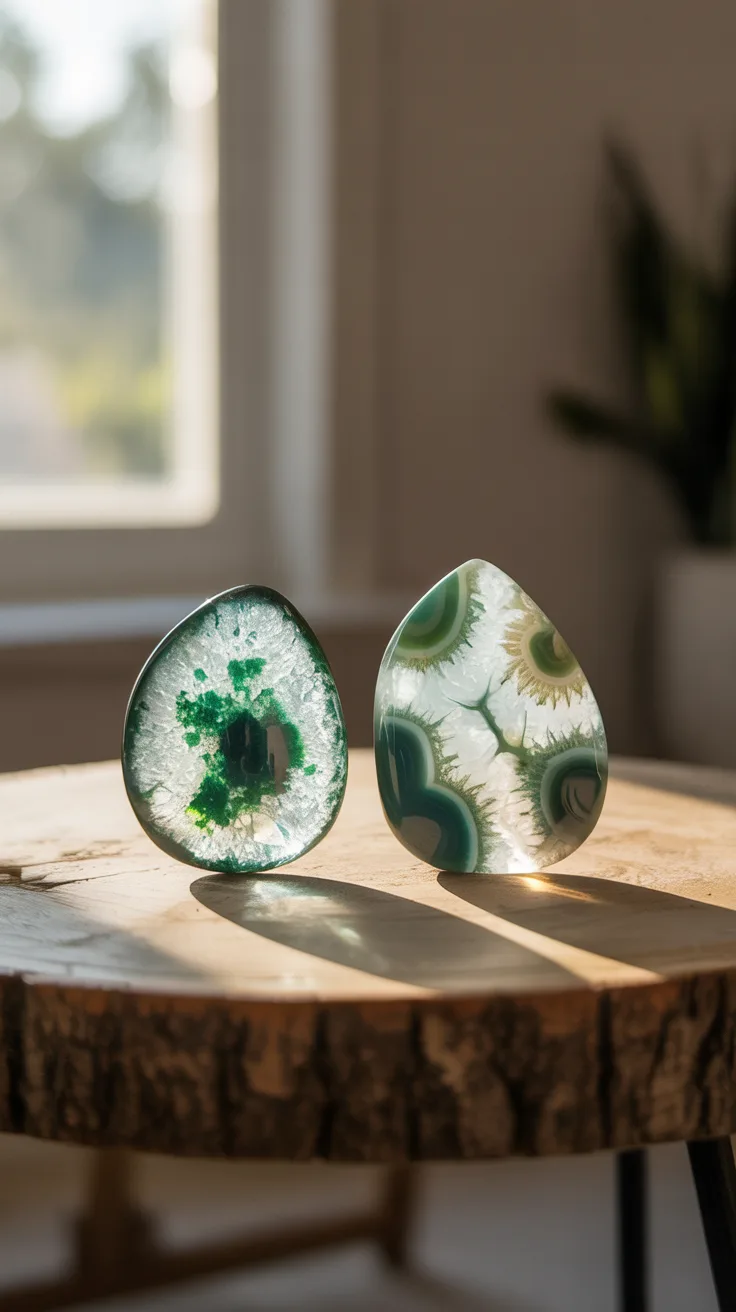
Several factors influence the relative value of moss agate vs tree agate in the gemstone market. Generally, high-quality moss agate commands higher prices than comparable tree agate specimens due to several factors:
- Transparency quality: Clearer moss agate with vivid inclusions fetches premium prices
- Pattern uniqueness: Unusual or particularly artistic patterns increase value
- Color intensity: Deep, vibrant greens prove more valuable than pale specimens
- Size and cuttability: Larger pieces suitable for cabochons or carvings command higher prices
Tree agate typically sells at lower price points, making it an excellent choice for beginners or large-scale jewelry projects. However, exceptional specimens with intricate dendritic patterns can rival moss agate prices.
Before comparing prices, try to compare stones of similar size, polish, pattern quality, and overall condition. For moss agate, pay particular attention to clarity and the depth of the inclusions, while tree agate can be judged more heavily on the contrast and complexity of its branching patterns.
7. Jewelry Applications and Best Uses
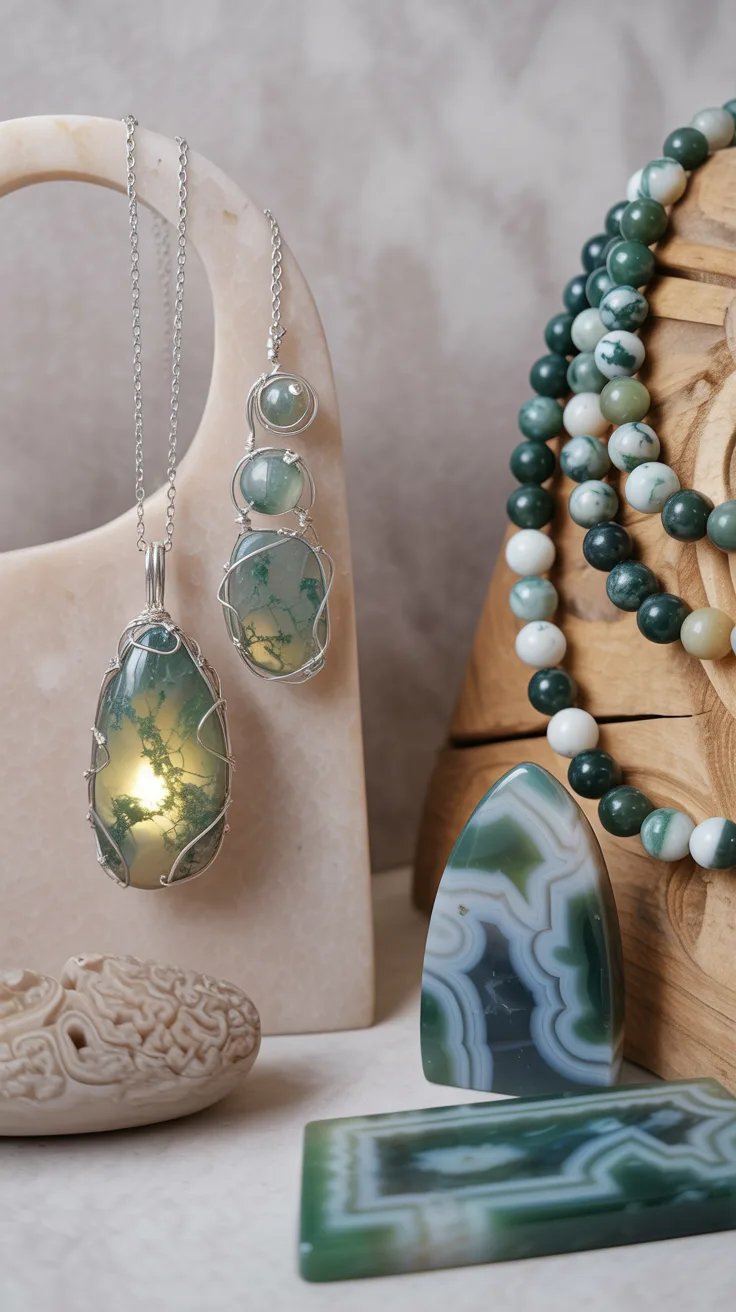
Each stone excels in different jewelry applications based on its unique characteristics. Moss agate’s transparency makes it ideal for:
- Pendant settings where light can pass through
- Ring cabochons showcasing depth
- Earrings catching and reflecting light
- Collector specimens displayed on light boxes
Tree agate’s opaque nature suits different applications:
- Beaded jewelry and strands
- Carved decorative objects
- Inlay work requiring consistent color
- Large statement pieces where pattern visibility matters more than light play
Before choosing a setting, hold the stone against different backgrounds and lighting conditions. Moss agate often benefits from designs that leave part of the back open so light can enter, while tree agate remains visually strong in settings where light transmission is not important.
For DIY pieces, a wire wrapping jewelry making kit for gemstones provides basic supplies for turning polished stones into pendants.
Pro Tip: For wire-wrapped jewelry, tree agate’s opacity prevents the wire from visually competing with the stone’s pattern, creating cleaner designs.
Caring for Both Stones
Despite their differences, moss agate and tree agate require similar care routines. Both stones tolerate gentle cleaning with warm soapy water and a soft brush. Avoid ultrasonic cleaners, harsh chemicals, and extreme temperature changes that could damage either stone.
Store both varieties separately from harder gemstones to prevent scratching. While their 6.5-7 hardness rating provides reasonable durability, diamonds, sapphires, and other harder stones can damage their polished surfaces.
Collectors who keep multiple loose specimens can use gemstone storage and display boxes to keep individual stones separated.
Frequently Asked Questions
Can moss agate and tree agate be used interchangeably in jewelry?
While both stones work well in jewelry, their different optical properties affect the final appearance. Moss agate suits designs emphasizing light transmission, while tree agate works better for opaque, pattern-focused pieces. Substituting one for the other changes the aesthetic significantly.
Which stone is more durable for everyday wear?
Both stones share identical hardness ratings and durability characteristics. Neither proves more suitable for daily wear than the other. The choice between them should focus on aesthetic preferences rather than durability concerns.
Are moss agate and tree agate actually agates?
Technically, neither stone qualifies as true agate, which requires banded patterns. Both belong to the chalcedony family and received their “agate” names historically due to their similar composition and appearance to banded agates.
How can beginners tell these stones apart quickly?
The simplest test involves checking transparency. Hold the stone against a light source—if light passes through, it’s moss agate. If the stone remains completely opaque with a white base, it’s tree agate.
Do these stones have different metaphysical properties?
In crystal healing traditions, moss agate associates with abundance and new beginnings, while tree agate connects with inner peace and stability. However, these attributions vary among practitioners and lack scientific verification.